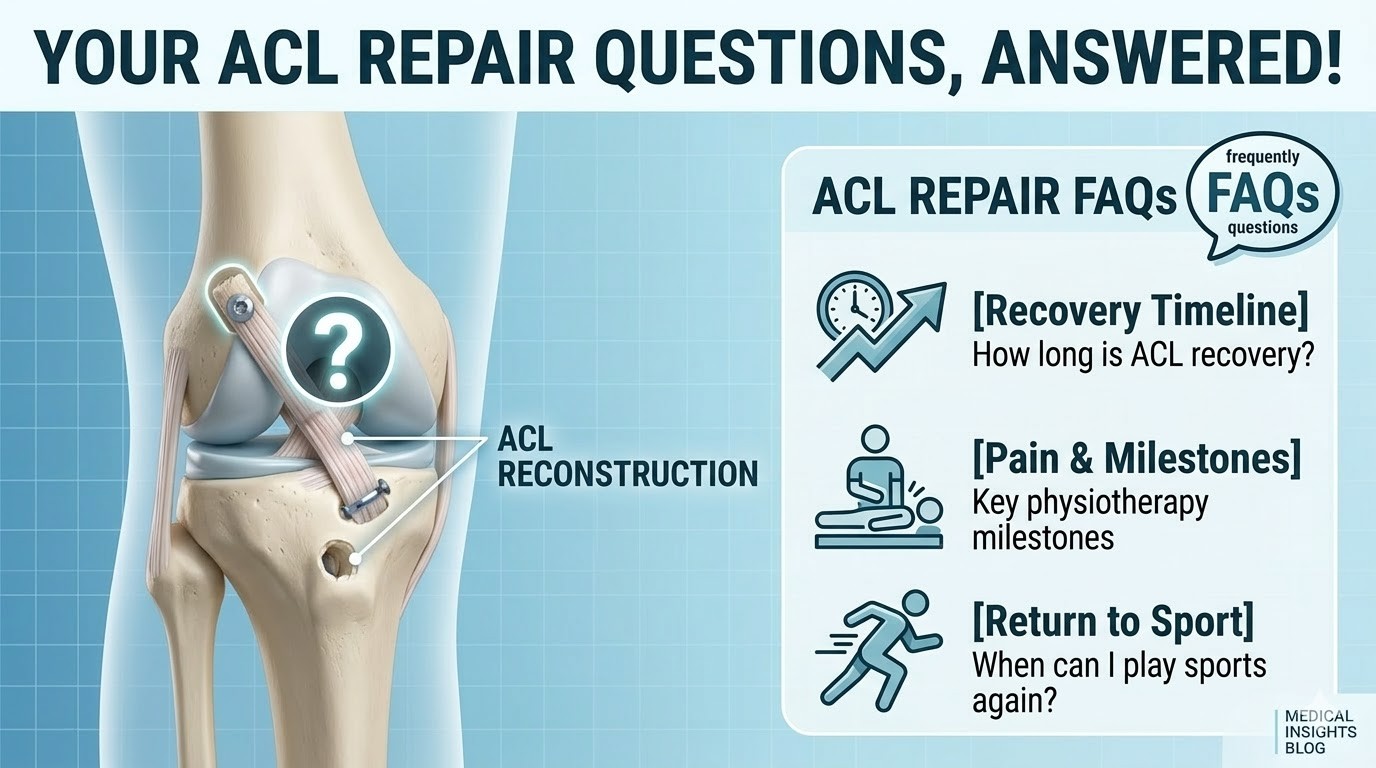
Follow evidence-based ACL reconstruction and meniscus repair rehab guidelines to optimize healing, knee stability, and return-to-sport outcomes.
This document outlines the post-operative rehabilitation guidelines following ACL reconstruction with meniscus repair under the care of an orthopaedic knee specialist. These recommendations reflect current evidence-based practice designed to restore knee stability, motion, strength, and athletic performance while protecting the surgical repair. Recovery timelines may vary slightly between individuals; however, adherence to these principles optimizes healing and return-to-sport outcomes.
1. What procedure did I undergo?
You underwent Anterior Cruciate Ligament (ACL) reconstruction with concomitant meniscus repair.
The ACL is a primary stabilizer of the knee, particularly during pivoting, cutting, and jumping activities.
The meniscus plays a critical role in load transmission, shock absorption, and joint stability.
Both structures require early controlled motion and progressive loading to achieve optimal healing.
2. Am I allowed to bear weight immediately?
Yes.
Full weight bearing is permitted immediately, as tolerated.
Crutches may be used initially for comfort and gait normalization and discontinued as strength and control improve.
⚠️ Key precaution:
Avoid combined weight bearing with knee flexion beyond 90° in the early phase of recovery.
Activities such as deep squatting, loaded lunges, or low sitting positions while standing on the surgical leg should be avoided initially.
3. Can I move my knee right away?
Yes. Immediate range of motion is encouraged.
Early motion reduces stiffness, swelling, and the risk of arthrofibrosis.
Achieving and maintaining full knee extension is a priority from the first post-operative day.
🎯 Clinical goal:
Full knee range of motion by 4 weeks post-operatively
4. Why is loaded flexion beyond 90° restricted early?
The restriction is to protect the repaired meniscus.
Deep knee flexion under load increases shear and compressive forces across the meniscus repair site.
Knee flexion beyond 90° is permitted without weight bearing, but not during standing or loaded activities early in rehabilitation.
This strategy balances meniscal protection with accelerated functional recovery.
5. When does strengthening begin?
Phase I: Weeks 0–4 | Protection & Activation
Focus:
Swelling and pain control
Restoration of full knee extension
Normalization of gait mechanics
Early activation of quadriceps, gluteal, hamstring, and calf musculature
Phase II: Months 1–2 | Strength & Control
Focus:
Progressive lower-extremity strengthening
Hip and core stability
Balance and neuromuscular control
🎯 Clinical goal:
A strong, stable knee capable of controlled daily activities
6. When may I begin jogging?
🏃 Approximately 3 months post-operatively
Initiation of straight-line, low-impact jogging
Only after demonstration of adequate strength, movement control, and minimal to no effusion
Jogging serves as a functional readiness milestone, not a performance benchmark.
7. When may I progress to running?
🏃♂️ Approximately 4 months post-operatively
Gradual progression from jogging to running
Emphasis on endurance, mechanics, and controlled acceleration/deceleration
8. When can I return to recreational sports or endurance events?
🏊🚴🏃 Approximately 5 months post-operatively
Return to non-contact recreational sports
Fun runs and controlled participation in triathlon events
The emphasis remains on movement quality, conditioning, and confidence rather than competition.
9. When can I return to contact or high-demand sports?
🏀⚽🏐🚵 Approximately 6 months post-operatively, with clearance
High-demand sports such as:
Basketball
Soccer / Football
Volleyball
Aggressive or technical cycling
Return is contingent upon:
Strength symmetry between limbs
Dynamic stability and neuromuscular control
Sport-specific movement competency
Clearance by your orthopaedic surgeon and physical therapist
10. What factors most influence a successful outcome?
The strongest predictors of success include:
Consistent participation in structured rehabilitation
Adequate sleep and nutrition
Effective swelling management
Progressive loading without premature return to high-risk activities
Rehabilitation is an active process — precision and patience matter.
11. What should I avoid early in recovery?
❌ Loaded deep squatting or lunging
❌ Pivoting or twisting on a flexed knee
❌ Playing through swelling or pain
❌ Advancing activity without guidance
12. Final message
ACL reconstruction with meniscus repair is a highly successful procedure when paired with appropriate rehabilitation.
With adherence to these guidelines, most patients:
Restore full motion
Regain strength and neuromuscular control
Safely return to sport and high-level activity
If questions or concerns arise at any stage of recovery, early communication with your care team is encouraged.
This rehabilitation process is not simply recovery — it is structured restoration of knee performance.